| DETAILS |
|---|
The H2Ohio Wetland Monitoring ProgramOHSU-TS-1541 The H2Ohio Wetland Monitoring Program will assess the impacts that wetland restoration can have on removal of phosphorus and nitrogen, key nutrients that fuel eutrophication and harmful algal blooms, across Ohio. The ODNR-implemented wetland projects that are part of the H2Ohio Initiative represent a wide range of wetland types, construction approaches, and complexity. To improve wetland restoration design and management into the future, it’s necessary to understand the processes happening within wetlands. This comprehensive approach to determining not only whether a wetland is effective, but also how the wetland systems work and how to better design and manage wetlands for nutrient removal, is led by scientists from throughout Ohio with expertise in wetland ecology, nutrient biogeochemistry, hydrology, plant sampling and identification, soil science, data synthesis and analysis. LENGTH: 1 page Download (4.33 MB) Full Detail Page |
Fish Health on the Farm: What Can I Do and Resources When It’s Beyond MeOHSU-CAST-1669 Join the Great Lakes Aquaculture Collaborative and Ohio Sea Grant for a webinar about identifying fish health problems, what you can do on the farm to prevent and treat problems, and when to ask for help from a vet or diagnostics lab! Expected audience includes fish producers and community members. Participants within the Great Lakes region are especially encouraged to attend, but all are welcome! Our speakers will help you determine when a problem is beyond you and it’s time to ask for help! Join us for a series of short presentations followed by a question-and-answer session with our panelists. LENGTH: 107 pages |
Ripple Rock Fish Farms - Great Lakes Aquaculture Days 2021OHSU-CAST-1670 Video tour of Ripple Rock Fish Farms as part of Great Lakes Aquaculture Days 2021 DURATION: 33 mins |
Fish to Fork: Cooking Great Lakes Fish WebinarOHSU-CAST-1662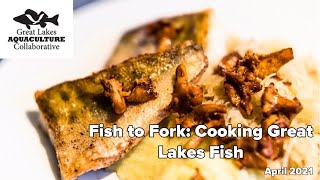 Join the Great Lakes Aquaculture Collaborative and Ohio Sea Grant for a webinar about resources for Great Lakes fish and a demonstration of how to dress, prepare, and cook fish at home! Preparing fish at home may seem intimidating, but you can do it! Seafood is an important and nutritious source of protein we can all benefit from in our diets. This webinar will show you how to choose, prepare (from whole to fillet), and cook fish so you can take advantage of great fish in the Great Lakes. You’ll also learn about resources to find the freshest fish from commercial fisheries and fish farms in the region. DURATION: ~ 2 hrs, 57 mins |
Twine Line Spring/Summer 2019OHSU-TL-1559 Ohio Sea Grant education expands Lake Erie knowledge across the region through professional learning opportunities and curriculum lessons. Read about how educators have applied what they learned at Stone Lab and elsewhere in this issue of Twine Line.
VOLUME: 41 ISSUE: 2 LENGTH: 19 pages Download (6.88 MB) Full Detail Page |
Stone Lab Guest Lecture: ODNR Division of WildlifeOHSU-CAST-1611 Research Brief Guest Lecture DURATION: ~ 1 hr, 46 mins |
Twine Line Winter/Spring 2018OHSU-TL-1555 Twine Line Winter/Spring 2018. Twine Line gets ready for summer. Learn how travel benefits our state and the ways that research at Stone Lab is improving the quality of our drinking water, plus lots more in this issue of Twine Line. VOLUME: 40 ISSUE: 1 LENGTH: 19 pages Download (7.70 MB) Full Detail Page |
Great Lakes Sea Grant Network Education and Outreach on Asian Carp ReportOHSU-TB-1511 Report explaining the dangers, history, and status of Asian Carp in the Great Lakes, and it provides materials and contact info for those seeking more information or to educate others on Asian Carp. LENGTH: 55 pages Download (5.58 MB) Full Detail Page |
The Cuyahoga River Area of ConcernOHSU-FS-1505 The Cuyahoga River isn’t at risk of catching fire anymore, but that doesn’t mean it’s in great shape either. The Cuyahoga River is a designated Area of Concern. This fact sheet explains what that means, and what’s being done to fix it. LENGTH: 1 page Download (2.78 MB) Full Detail Page |
Microcystin Concentrations in Lake Erie Walleye and Implications for Public HealthOHSU-TD-1511 ABSTRACT: Cyanobacterial harmful algal blooms (HABs) degrade water quality of western Lake Erie and create negative economic impacts on an annual basis. Public health is at the forefront of concern because these blooms are often toxic due to an abundance of Microcystis. This genus of cyanobacteria produces the toxin microcystin, which causes gastrointestinal illnesses, damages the liver, and is capable of promoting tumors or death of animals (Poste et al 2011). The World Health Organization (WHO) has set values for microcystin in drinking water, recreational contact, and total daily consumption, but no standards exist for concentrations of microcystin in food. Because microcystin can accumulate in fish tissues, and fishing and fish consumption are important economic and cultural practices in Lake Erie, there is a potential health risk to humans via consumption of fish inhabiting waters with high concentrations of microcystin.
Walleye is one of the most significant sportfish of Lake Erie, and a previous study found this species can have greater microcystin concentrations than yellow perch and white perch studied in the same time period (Wituszynski 2014). For these reasons, this study quantified microcystin levels in walleye tissue using an enzyme-linked immunosorbent assay (ELISA) and compared to public health thresholds used by the Ohio Department of Natural Resources (ODNR). Samples were harvested at different times and from locations in attempt to understand the seasonal correlation between bloom intensity and microcystin concentration, and impacts of variations in bloom intensity at different locations. The effects of chronic exposure of fish to microcystin has not been widely studied for Lake Erie, and no studies presently exist which have examined year-to-year variation in microcystin content in fish. Thus, by comparing this study to a similar study conducted in 2013 (Wituszynski 2014), we can aid in identifying correlation between annual variation in HABS, determine if previous exposure has an effect on accumulation in fish, and understand when microcystin concentrations in fish tissues may be at its peak when compared to HAB intensity. LENGTH: 21 pages Download (687.11 KB) Full Detail Page |
Feeding Ecology of the Invasive Round Goby, Neogobius melanostomus (Pallas, 1814), Based on Laboratory Size Preference and Field Diet in Different Habitats in the Western Basin of Lake ErieOHSU-RS-1523 ABSTRACT: The round goby, Neogobius melanostomus, is an invasive benthic fish species in the Laurentian Great Lakes that is threatening native fish populations through competition, predation, and trophic dynamic change. This study examined the trophic dynamic plasticity of round goby along a depth gradient based on laboratory and field observations to determine prey species consumed and mussel prey size selection. Prey size selection in the laboratory was assessed by presenting individual round goby with quagga mussels (Dreissena rostriformis bugensis) of various class sizes (i.e., 6.0–9.9 mm, 10.0–12.9 mm, 13.0–15.9 mm, and 16.0–18.9 mm in length). Round goby exhibited a selection preference for small sized quagga mussels, although in individual trial events, mussels were consumed from all four size classes. Prey species consumed from shallow and deep sites in the western basin of Lake Erie were assessed using individual gut contents to calculate measures of prey importance, diversity, and dominance. Based on the Index of Relative Importance (IRI), Cladocera was found to be the most consumed prey item for both males and females and between study sites. Both sexes consumed a variety of prey items although females exhibited greater prey dominance or reliance on one prey item. Round goby individuals at the shallow, natural shoreline site had the highest trophic diversity, while individuals at the deep site exhibited the highest prey dominance. Diet of round goby in the western basin of Lake Erie are mainly dominated by just a few prey items. |
A population genetic window into the past and future of the walleye Sander vitreus: relation to historic walleye and the extinct “blue pike” S. v. “glaucus”OHSU-RS-1511 ABSTRACT: Conserving genetic diversity and local adaptations are management priorities for wild populations of exploited species, which increasingly are subject to climate change, habitat loss, and pollution. These constitute growing concerns for the walleye Sander vitreus, an ecologically and economically valuable North American temperate fish with large Laurentian Great Lakes’ fisheries. This study compares genetic diversity and divergence patterns across its widespread native range using mitochondrial (mt) DNA control region sequences and nine nuclear DNA microsatellite (μsat) loci, examining historic and contemporary influences. We analyze the genetic and morphological characters of a putative endemic variant– “blue pike” S. v. “glaucus” –described from Lakes Erie and Ontario, which became extinct. Walleye with turquoise-colored mucus also are evaluated, since some have questioned whether these are related to the “blue pike”. |
Aquatic Ecology Products
Products filtered by tags labeled aquatic-ecology